
Two new SEE-GL publications: knowledge and skills for the green transformation of transport and logistics
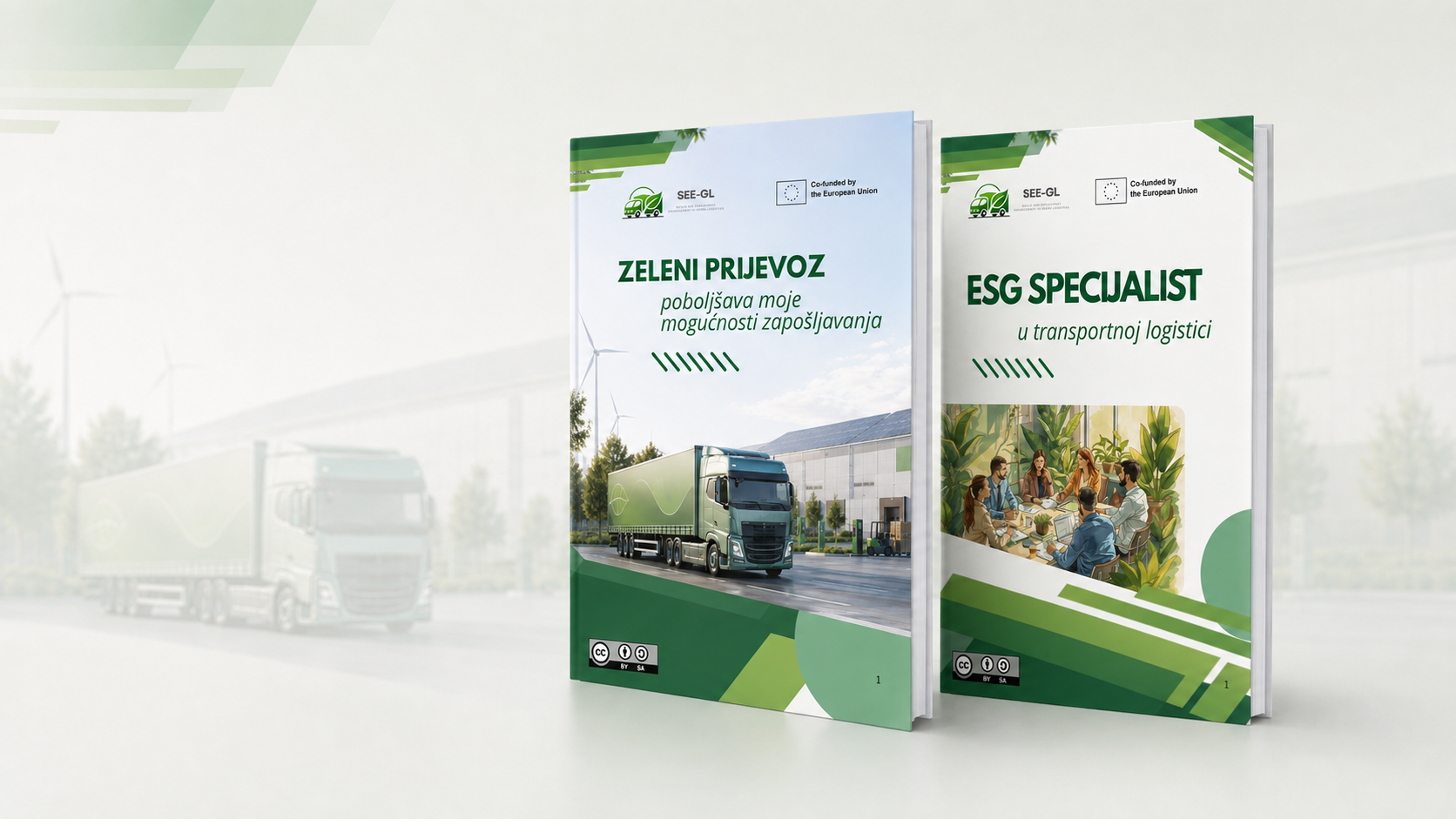
Within the Erasmus+ project SEE-GL – Skills and Employment Enhancement in Green Logistics, on which Pannonia Consulting takes part as a project partner, two new publications have been released, both aimed at developing ESG competences and at helping the transport and logistics sector adapt to the green transition.
SEE-GL brings together organisations from Croatia, Slovenia, Bosnia and Herzegovina, Kosovo and Montenegro with the aim of modernising vocational education and training and connecting it better with new labour market needs. One of the project’s central goals is precisely the development of a new professional profile: the ESG specialist in transport logistics.
Green transport improves my employment prospects
The publication “Green transport improves my employment prospects” is a practical guide that ties the green transition to a very concrete question: how changes in transport and logistics affect jobs, the competences they call for, and future employment prospects.
The guide is written for people working in transport and logistics, for learners in vocational education, for trainers and for employers. It treats ESG not merely as a concept tied to corporate reporting, but translates it into everyday working situations: fuel consumption, emissions and waste management, employee safety, documentation, compliance and record keeping.
Particular emphasis falls on the fact that the green and digital transition will change almost every occupation in the sector. Drivers will meet new technologies and vehicles, dispatchers will deal with route planning and low-emission zones, warehouse staff with new demands on managing resources and waste, and administrative staff with growing requirements for digital data and evidence of compliance. Building ESG literacy thus becomes a question not only of sustainability, but of employability, job security and professional development.
The publication is strongly practical. It offers readers a simple 30-day plan, for instance, through which they can identify the ESG area connected to their own job, start tracking data systematically, propose an improvement and check its effect in practice.
Pannonia Consulting also had a particular part in this publication through its editorial coordination, as co-lead of work package WP5, while the lead partner for this result was Z&S Global from Montenegro.
ESG specialist in transport logistics
The second publication, “ESG specialist in transport logistics”, sets out a fully worked educational programme that carries ESG principles into vocational education and training.
The programme is designed to give learners not only a theoretical grasp of the environmental, social and governance sides of business, but the ability to apply them in logistics and transport processes.
It runs to 100 hours in total: 24 hours of guided learning, 42 hours of learning at the workplace and 34 hours of independent work. Theory is thereby tied directly to real or simulated situations in warehouses, logistics centres and transport companies.
The programme covers subjects such as an introduction to ESG and sustainable logistics, international ESG standards and regulations, the environmental dimension of business, social responsibility, corporate governance, ESG reporting and digital tools, and the application of legal norms and sustainability principles in a national and local context.
Learners build competences for understanding ESG regulation, planning business processes in line with ESG principles, understanding the role of management in carrying them out, using digital technology, and continually improving the quality and sustainability of logistics operations.
From European policy to concrete competences
For Pannonia Consulting, taking part in these results continues our work on connecting EU policy, education and what the labour market actually needs. The green transition will not happen through new rules and technology alone. It calls for people who understand what the changes mean for their everyday work and who have the knowledge to carry them out.
That is what the two new SEE-GL publications share: one brings ESG closer to employees and shows how new competences can improve their employability, while the other provides a structured educational framework for building those competences.
Both publications are part of the wider aim of SEE-GL: to help transport and logistics answer the green transition with new knowledge, better education and a workforce ready for what comes next.
The publications are available on the SEE-GL project website: esg-logistic.eu.