
The green transition of logistics in the region
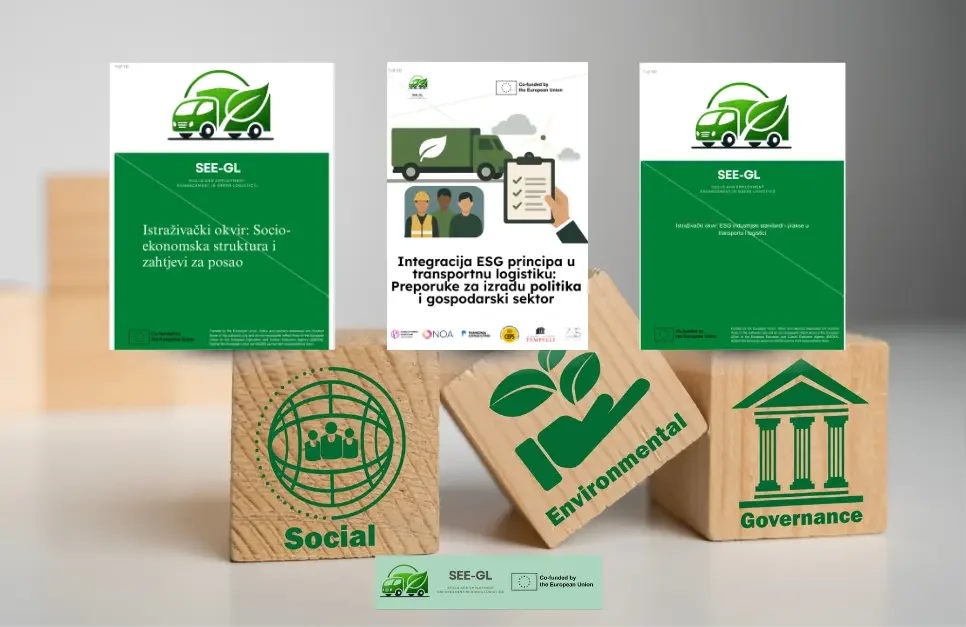
Transport and logistics in South-East Europe face a double challenge: the need to decarbonise urgently, and a shortage of the qualified workforce that could carry the change through. In answer, the project SEE-GL (Skills and Employment Enhancement in Green Logistics), co-funded by the European Union, offers solutions through three foundational documents. These reports are not only a theoretical survey; they are a concrete route map for modernising vocational education and business practice in Croatia, Slovenia, Bosnia and Herzegovina, Montenegro and Kosovo.
Below is an overview of the three key documents that set the direction of the project.
1. Research framework: ESG industry standards and practice in transport and logistics
The first document (D2.1) is a detailed diagnosis of where things stand. Analysing how environmental, social and governance standards are applied, the report reveals a “north-south” divide in the region. Croatia and Slovenia, as EU members, are further into implementing regulation and sustainability reporting, while the other countries are only beginning to align, often driven by what foreign partners in the supply chain require. The document maps the key stakeholders clearly and concludes that, although awareness of green logistics is growing, infrastructure capacity and legal frameworks often lag behind European ambitions. This is the document for understanding where we are now.
2. Research framework: socio-economic structure and job requirements
A green transition is impossible without people. The second document (D2.2) looks at human capacity and identifies a critical gap between the skills the education system supplies and the ones employers need. Drawing on research with more than 50 stakeholders, the report detects a pressing need for new professional profiles, such as the “ESG manager in logistics” and drivers trained in eco-driving. The analysis shows employers increasingly asking for digital literacy and the soft skills of managing change, while the curricula of vocational schools are often out of date. The document provides the empirical basis for reforming educational programmes so that future workers are employable and competitive.
3. Integrating ESG principles into transport logistics: recommendations for policy and industry
The third document (D2.3) synthesises the findings of the first two into a concrete action plan. It answers the question of how to move forward. It offers guidance to policy makers and educational institutions on bringing ESG principles into everyday practice. The key recommendation is to create synergy between industry and schools, from practical teaching on green technologies to lifelong learning for people already in work. Without a coordinated approach of this kind, the sector risks losing its competitiveness on the European market.
Together the three documents are a powerful tool for a change of paradigm. They serve not only as reports on the state of play, but as a foundation for building a sustainable, green future for transport in our region, making logistics a driver of economic development rather than a brake on it.

Funded by the European Union. Views and opinions expressed are however those of the author(s) only and do not necessarily reflect those of the European Union or the European Education and Culture Executive Agency (EACEA). Neither the European Union nor EACEA can be held responsible for them.